International Visitors and Guest Lecturers
The Laboratory of Environmental Biogeochemistry, Microbial Mineralization, and Sustainable Materials (EBMM Lab), Department of Earth and Environmental Sciences at National Chung Cheng University, welcomes international scholars for guest lectures, academic discussions, and interdisciplinary micro-credit courses.
Planned and coordinated by Professor Chien-Yen Chen, these international programs connect environmental science with sustainable agriculture, green technology, women’s leadership, higher education, philosophical inquiry, social welfare, and University Social Responsibility (USR). By learning from visiting scholars and participating in cross-cultural dialogue, students broaden their international perspectives and develop the interdisciplinary capabilities needed for sustainable development and green industries.
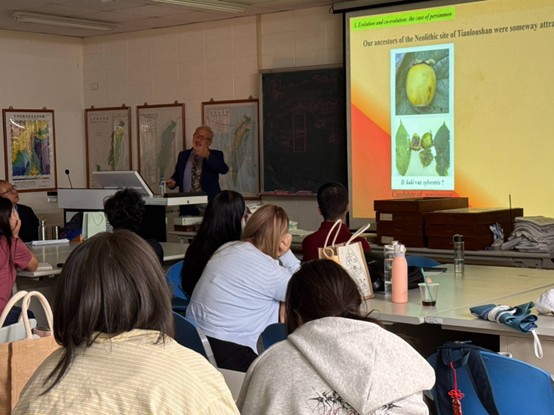
University of Florence Italy
Dr. Edgardo Giordani
Position: Professor
Affiliation: Department of Agriculture, Food, Environment and Forestry (DAGRI), University of Florence, Italy
Guest course:
Evolving Fruit Culture: Raw Materials, Finished Products, Environmental Impact, and Consumers
Date: August 19, 2026
Course duration: 4 hours
Co-instructor: Professor Chien-Yen Chen
Venue: Room 106, Department of Mathematics, National Chung Cheng University
Dr. Edgardo Giordani and Professor Chien-Yen Chen jointly taught an international micro-credit course using fruit cultivation and the agri-food industry in Italy as examples. The course introduced the full value chain of the fruit industry, from raw-material production, cultivation management, harvesting, and processing to finished products and consumer markets.
Topics included the effects of climate change on fruit production, soil carbon management and carbon sequestration, efficient use of agricultural resources, circular reuse of agricultural by-products, and practical strategies for reducing the carbon footprint of food production. Comparisons between agricultural examples from Italy and Taiwan encouraged students to consider how the fruit industry can transition toward net-zero emissions and a circular economy.
The course also introduced development and employment opportunities for women in sustainable agriculture, agricultural technology, carbon management, the green food industry, and other areas of research and development related to green careers. It encouraged more female students to pursue STEM and sustainability-related professions.
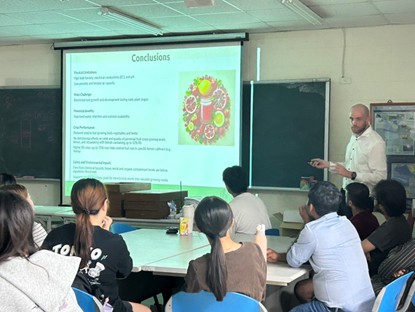
Dr. Lorenzo Bini
Affiliation: Department of Agriculture, Food, Environment and Forestry (DAGRI), University of Florence, Italy
Guest course:
Effects of Non-Conventional Substrates and Treated Wastewater on Fruit Crops Cultivated in Soilless Systems
Date: August 19, 2026
Course duration: 4 hours
Co-instructor: Professor Chien-Yen Chen
Venue: Room 106, Department of Mathematics, National Chung Cheng University
Dr. Lorenzo Bini and Professor Chien-Yen Chen jointly taught an interdisciplinary course focused on sustainable agriculture, circular resource use, and climate resilience. The course introduced the scientific principles and practical methods for using non-conventional growing substrates and treated wastewater (reclaimed water) in soilless fruit cultivation.
The course explained how different growing substrates affect root development, nutrient uptake, plant growth, and fruit quality. It also examined the feasibility of using reclaimed water for agricultural irrigation, including water quality, nutrients, salinity, and potential environmental impacts.
Through examples of soilless fruit cultivation and reclaimed-water use in Italy, students learned how innovative agricultural technologies can reduce freshwater consumption, recover resources from agricultural waste, lower carbon emissions, and enhance the carbon storage potential of growing substrates. The course also connected these technologies with circular agriculture, net-zero emissions, carbon management, and the Sustainable Development Goals.
Hiroshima University Japan
Assoc. Prof. Dr. Mitsuyo Saito
Position: Associate Professor
Affiliation: Graduate School of Advanced Science and Engineering, Hiroshima University, Japan
Visit dates: June 29 to July 3, 2026
Activities: Public lectures, research exchange, technical guidance, and joint graduate student training
Host: Professor Chien-Yen Chen, Department of Earth and Environmental Sciences, National Chung Cheng University
Associate Professor Mitsuyo Saito specializes in hydrogeology, biogeochemistry, and coastal oceanography. Her long-standing research interests include Submarine Groundwater Discharge (SGD), nutrient transport from land to sea, groundwater–ocean interactions, and blue carbon ecosystems such as seagrass meadows and seaweed beds.
She combines field surveys, long-term environmental monitoring, hydrological modeling, radon-222 tracing, and nutrient analysis to investigate how phosphorus, nitrogen, silicon, and other substances enter coastal environments through groundwater and rivers. Her research also evaluates their effects on coastal ecosystems, biodiversity, and blue carbon functions.
Associate Professor Saito previously served as an associate professor at the Graduate School of Environmental and Life Science, Okayama University, Japan, and as a visiting professor in the Department of Geoscience at the University of Calgary, Canada. She also serves on the standing committee of the Japanese Association of Hydrological Sciences, as an associate editor of the Brazilian Journal of Geology, and as an active member of academic organizations including the Japan Geoscience Union. Her awards include the Yoshimura Award from the Japanese Society of Limnology, a Kurita Water and Environment Research Award, and the 2025 Academic Award from the Japanese Association of Physical Hydrology.
Public Academic Lectures
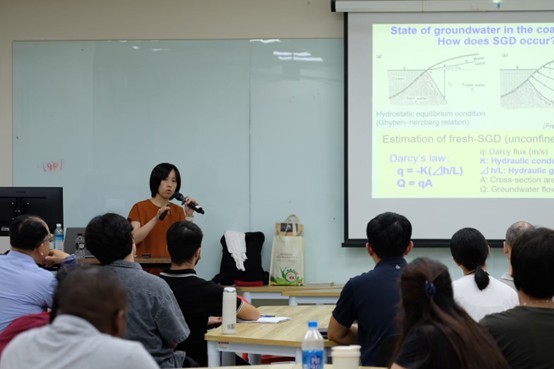
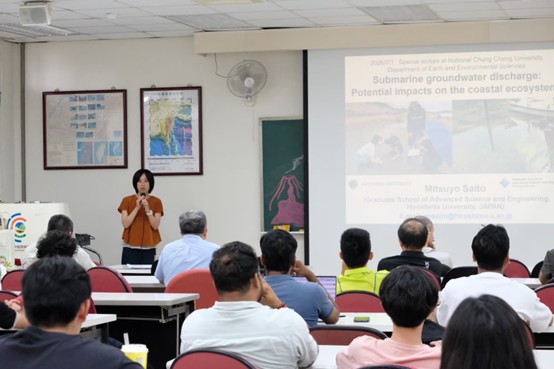
During her visit to Taiwan, Associate Professor Saito delivered two public academic lectures at the College of Science and Technology, Nanhua University, and the Department of Earth and Environmental Sciences, National Chung Cheng University.
Submarine Groundwater Discharge, Biogeochemical Cycling, and Environmental Sustainability in Coastal Regions
This lecture introduced the importance of submarine groundwater discharge in material exchange between land and sea. It explained how groundwater transports nutrients and substances of geological origin to coastal waters, and examined the resulting effects on coastal water quality, ecosystems, biogeochemical cycling, and environmental sustainability.
Land-Sea Interactions, Nutrient Transport, and Blue Carbon Ecosystems in Coastal Environments
This lecture focused on interactions among terrestrial catchments, groundwater, and the ocean. It examined how nutrient transport affects seagrass meadows, seaweed beds, and other coastal blue carbon ecosystems, and shared research experience from Japan in coastal environmental monitoring, blue carbon assessment, and sustainable management.
Research Exchange and International Collaboration
The research teams of Professor Chien-Yen Chen and Associate Professor Mitsuyo Saito have established a stable, long-term collaborative relationship. Their complementary expertise covers coastal environmental geochemistry, groundwater–ocean interactions, biogeochemical cycling, blue carbon ecosystems, microplastics, environmental DNA, stable isotope analysis, and marine environmental monitoring.
During the visit, the teams held in-depth discussions on the following research topics:
• Submarine groundwater discharge and coastal environmental monitoring
• Nutrient and pollutant transport from land to sea
• Biogeochemical cycling in groundwater and marine environments
• Stable isotopes and environmental forensic techniques
• Seagrass meadows, seaweed beds, and coastal blue carbon ecosystems
• Environmental DNA and coastal biodiversity assessment
• Marine pollution monitoring and ecological restoration
• Joint Taiwan–Japan research projects and collaborative international publications
Through laboratory visits, presentations of research findings, and focused discussions, the teams further planned joint research, international project applications, publications, short-term student exchanges, and co-supervision arrangements. These activities continue to strengthen academic collaboration between National Chung Cheng University and Hiroshima University.
Graduate Student Training and Doctoral Research Guidance
During her visit, Associate Professor Saito discussed research with doctoral and master’s students in EBMM Lab. She shared research methods and practical experience from Japan in groundwater environments, coastal hydrogeochemistry, nutrient cycling, and blue carbon ecosystems.
She was also invited to serve on the doctoral oral examination committee for doctoral candidate Jin-Wen Wang, offering advice from an international academic perspective on coastal environments, hydrogeology, biogeochemistry, and blue carbon research. Involving international scholars in graduate supervision and degree examinations helps improve students’ research quality, international communication skills, and perspectives on cross-border academic work.
Highlights of the visit:
• Two public lectures on coastal environments and blue carbon
• Advancement of research on groundwater–ocean interactions
• Exchange of techniques for nutrient transport and biogeochemical monitoring
• Discussion of integrated applications of environmental DNA, stable isotopes, and blue carbon research
• Participation in a doctoral oral examination and research guidance
• Planning of Taiwan–Japan student exchanges and joint training arrangements
• Development of joint research projects and international publications
• Strengthening of long-term collaboration between National Chung Cheng University and Hiroshima University
KIIT University India
Prof. Dr. Satyendra Patnaik
Position: Rector, KIIT University, India
Institution: KIIT University, India
International micro-credit program:
Micro-Credit Program on Cultivating Green-Collar Talents among Women Scientists through Science and Technology
Dates: May 4, May 5, and May 10, 2026
Total duration: 9 hours
Co-instructor: Professor Chien-Yen Chen
Venues: Room 106, Department of Mathematics, and Room 401, Department of Earth and Environmental Sciences, National Chung Cheng University
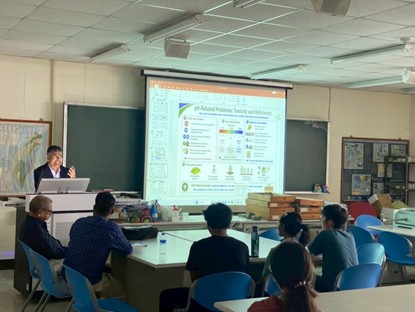
Prof. Dr. Satyendra Patnaik participated in three international micro-credit courses that brought together women’s empowerment in STEM, sustainable development, Indigenous traditional knowledge, innovation in higher education, and green career development.
Drawing on his experience in higher education governance, international educational cooperation, sustainable development, Indigenous and sociocultural studies, science and technology education, and women’s empowerment, Professor Patnaik guided students in examining how science, education, and University Social Responsibility can contribute to an inclusive, equitable, and sustainable future.
Women Scientists STEM Leadership and Green Talent Development
This course examined the roles of women scientists in scientific innovation and the global transition toward sustainability. It introduced trends in green technology, STEM education, and green talent development, and strengthened students’ understanding of women’s leadership in environmental technology, sustainable innovation, and global governance.
Science Indigenous Knowledge and Women’s Sustainability Initiatives
This course explored the integration of Indigenous traditional knowledge with modern science. It introduced women’s contributions to environmental governance, ecological conservation, community resilience, and local green innovation, with practical examples from India and other parts of Asia.
Higher Education Innovation Technological Innovation and Women’s Green Careers
This course explained how higher education can develop women’s capabilities for green professions and innovation. Topics included the internationalization of education, technological innovation, women’s entrepreneurship, green employment, University Social Responsibility, and examples of sustainable innovation led by women.
Mahamakut Buddhist University Thailand
Academic Delegation from the Isan Campus
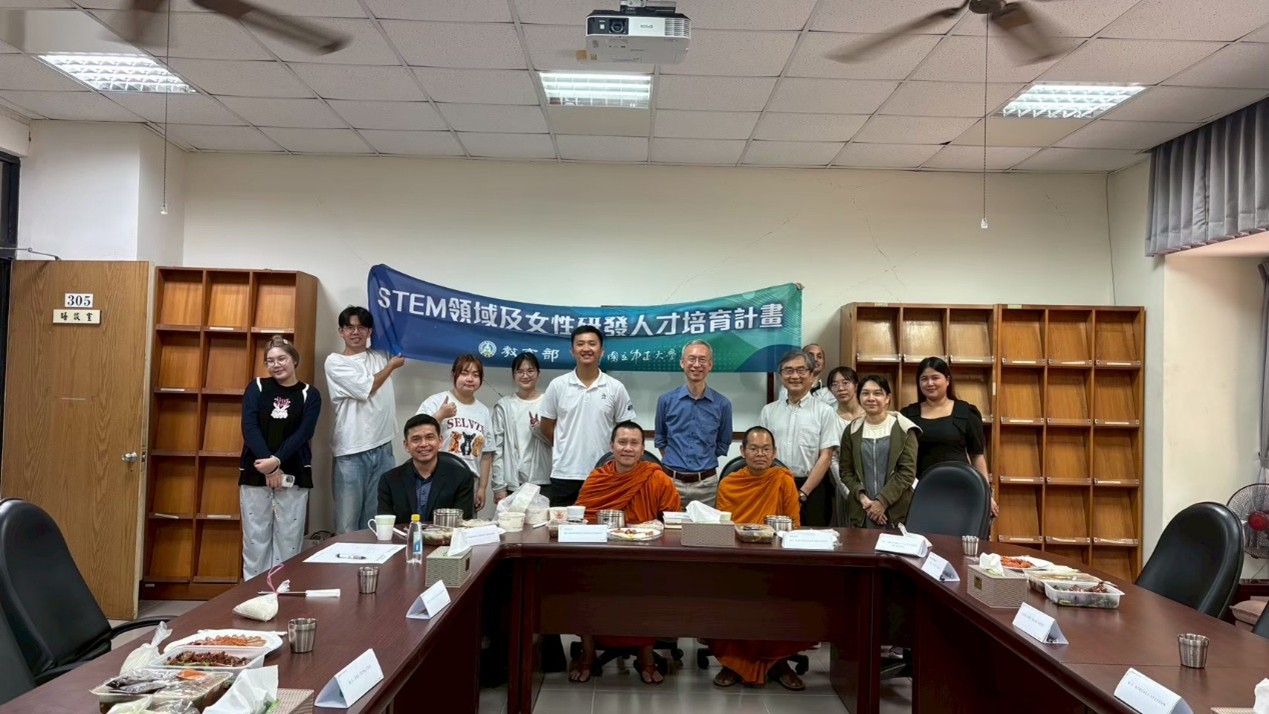
EBMM Lab hosted an academic delegation from the Isan Campus of Mahamakut Buddhist University, Thailand. The delegation included:
Assoc. Prof. Dr. Phramaha Supachai Supakijjo
Faculty member, Master’s Program in Educational Administration
Dr. Phramaha Sombat Taweekoon
Faculty member, Doctoral Program in Philosophy and Buddhist Studies
Assist. Prof. Dr. Sitthiporn Khetjoi
Faculty member, Master’s Program in Social Work and Social Welfare
International micro-credit program:
Women Scientists in Philosophy, Religion, and University Social Responsibility
Dates: April 28 to 29, 2026
Total duration: 9 hours
Venues: Department of Mathematics, College of Social Sciences, Earthquake Education Center, and Department of Earth and Environmental Sciences, National Chung Cheng University
These interdisciplinary international courses examined the roles and social influence of women scientists through educational leadership, philosophy, religion, social welfare, and University Social Responsibility. The visiting Thai scholars and Professor Chien-Yen Chen guided students in considering how science and technology can incorporate ethics, social inclusion, and humanistic values to address contemporary sustainability issues.
Women Scientists Educational Leadership and University Social Responsibility
Jointly taught by Professor Chien-Yen Chen and Assoc. Prof. Dr. Phramaha Supachai Supakijjo, this course explored the roles of women scientists in higher education, research leadership, and University Social Responsibility. It connected these roles with educational governance, gender equality, sustainable development, and interdisciplinary social engagement.
Women Scientists Practice and Reflection in Applied Philosophy
Jointly taught by Professor Chien-Yen Chen and Dr. Phramaha Sombat Taweekoon, this course examined the relationships between women scientists, philosophical inquiry, scientific ethics, and the application of knowledge. Topics included gender justice, Buddhist thought, social care, and ethical governance of emerging technologies.
Women Scientists and Social Welfare Innovation
Jointly taught by Professor Chien-Yen Chen and Assist. Prof. Dr. Sitthiporn Khetjoi, this course examined the relationships between women scientists, social work, social welfare systems, and social innovation. It also analyzed how science and technology can support disadvantaged groups, promote social inclusion, and contribute to long-term social sustainability.
Strengthening International Education and Green Talent Development
These visits and jointly taught courses demonstrate EBMM Lab’s efforts to connect scientific research and education with sustainable development, gender equality, and social responsibility. Through direct exchange with scholars from Italy, India, and Thailand, students broaden their international perspectives and develop the interdisciplinary knowledge and capabilities needed to address climate change, sustainable agriculture, environmental governance, and social transformation.
The courses also emphasize opportunities for women to participate in STEM and green industries, helping students explore future development and green careers in environmental science, carbon management, sustainable agriculture, water resource management, education, and social innovation.
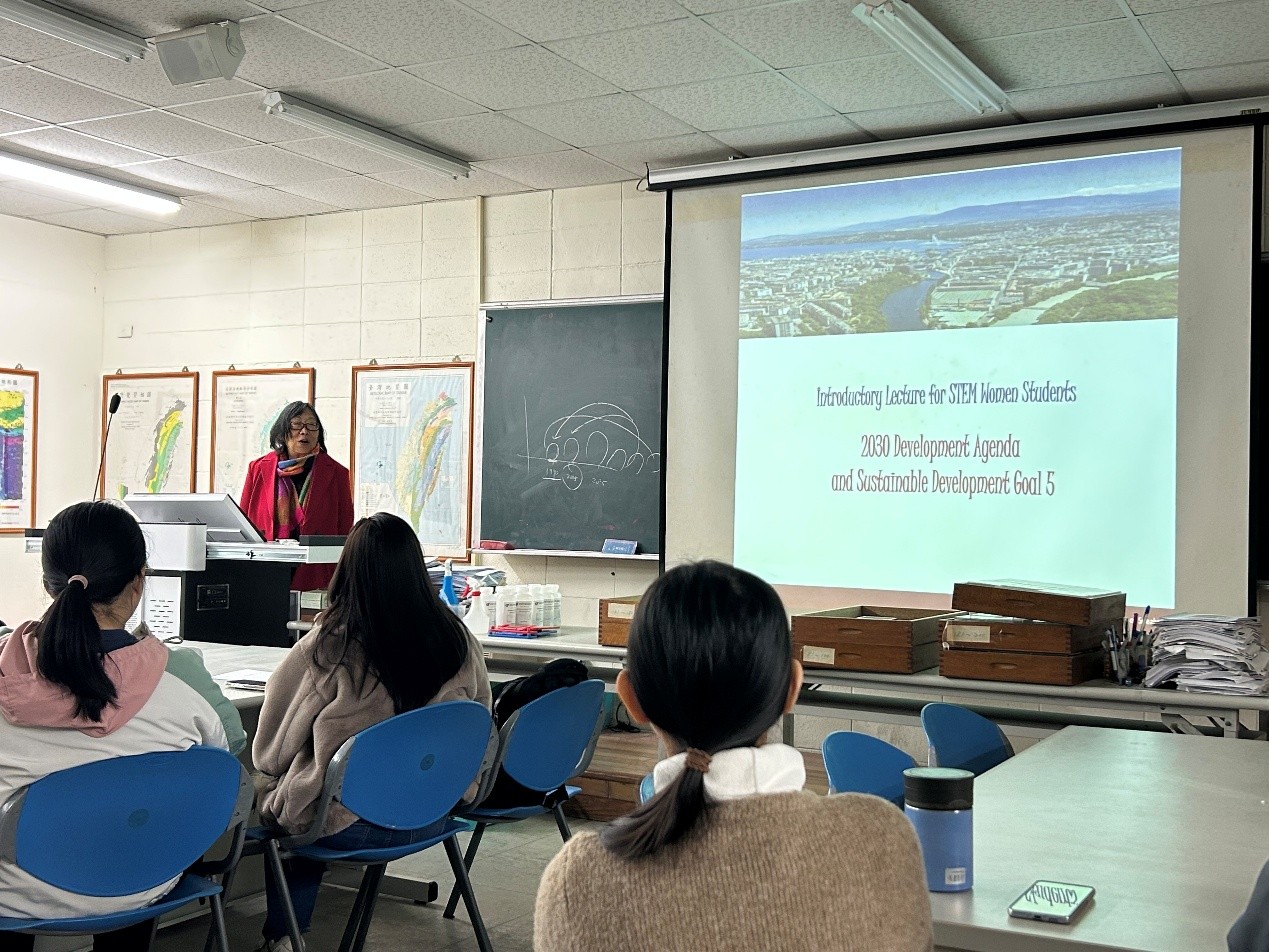
Centre for Socio-Eco-Nomic Development Geneva Switzerland
Prof. Raymond Saner
Professor of International Management and Organization, University of Basel
Co-Founder of the Centre for Socio-Eco-Nomic Development (CSEND)
Prof. Lichia Saner-Yiu
Co-Founder and President of CSEND
Advisor to the Sustainable Development Goals Division, United Nations Department of Economic and Social Affairs (UNDESA)
Sustainable Development Goals
Topic: Sustainable Development Goals (SDGs)
Date: January 8, 2026
Venue: Room 106, Mathematics Building, National Chung Cheng University
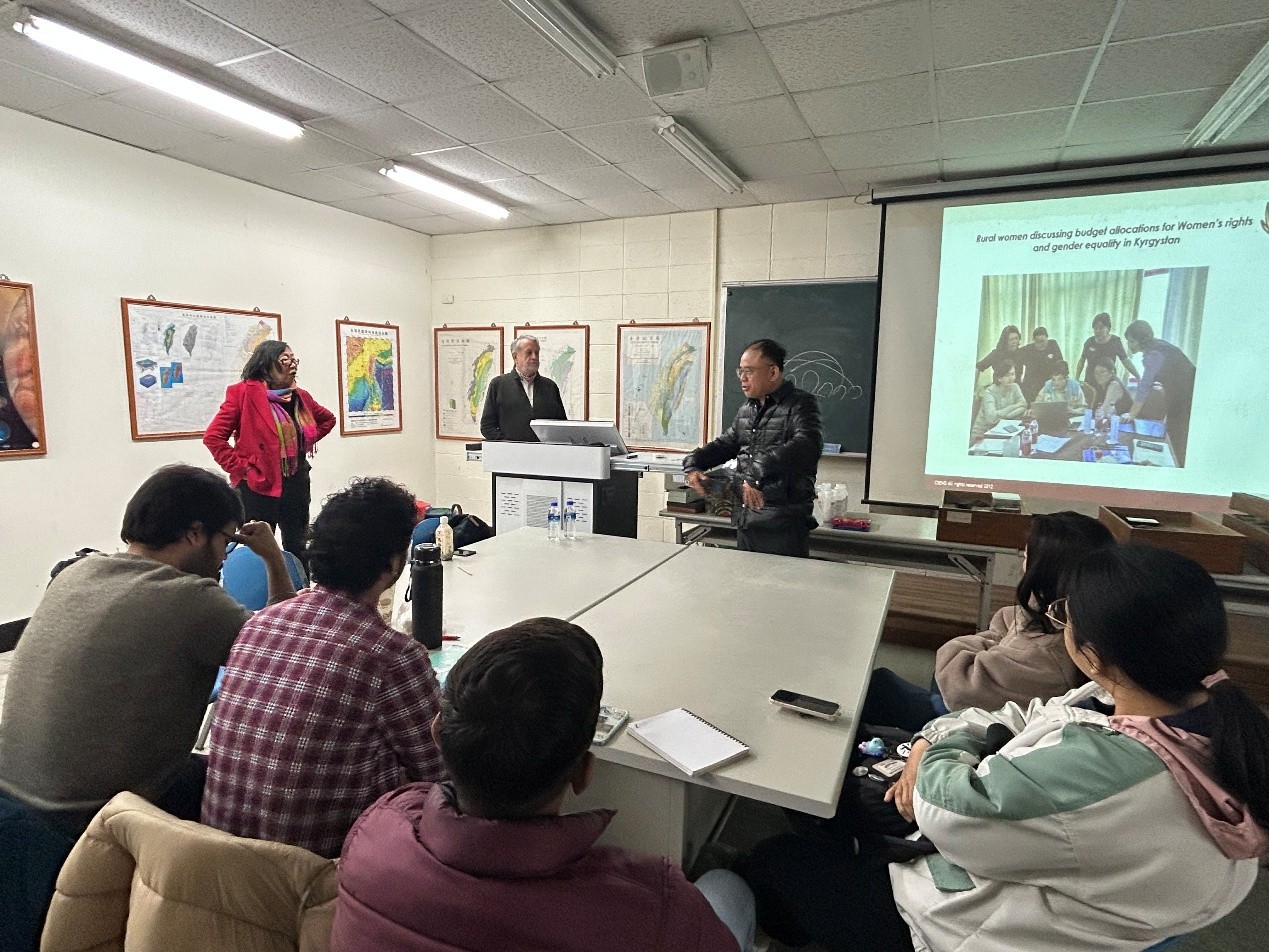
Professors Raymond Saner and Lichia Saner-Yiu introduced the United Nations Sustainable Development Goals (SDGs) and examined major trends in global sustainability governance, socioeconomic transformation, and international cooperation. The lectures explored how universities, governments, businesses, and communities can jointly address climate change, resource circularity, and the transition toward net-zero emissions.
Green-collar professionals work in areas such as resource circulation, renewable energy, pollution prevention, carbon management, and emissions reduction toward net zero. As the SDGs provide an international framework for the green transition, these lectures strengthened students’ understanding of global sustainability issues, their international perspectives, and the interdisciplinary capabilities needed for careers in carbon reduction, sustainability governance, and green industries.